

Online poker in the US runs on two tracks. Five states have licensed, regulated platforms. Everyone else – including the millions of players searching for online poker in California, online poker in Florida, and access from dozens of other states – plays on offshore sites operating under international licenses. That split creates real friction: card deposits fail, bonus terms differ, and legal clarity varies by zip code.
This guide cuts through that. You’ll get a state-by-state legal breakdown, verified operator data, real-money deposit and withdrawal guidance, and coverage of video poker, 3 card poker, free play, and bonus structures – everything you need to pick a site and start playing with confidence.

 9
9All sites except BC Poker accept players from California, Florida, and Arizona via offshore access. Crypto is the primary deposit route for US players at every offshore site – standard Visa and Mastercard cards frequently fail due to UIGEA banking restrictions on gambling transactions. If you’re playing online poker in California or accessing Florida online poker through an offshore room, Bitcoin or Ethereum will give you the most reliable deposit experience.
ACR Poker leads for tournament volume and US access breadth. CoinPoker leads for crypto speed and daily rewards. Bovada leads for anonymous tables and soft fields. Here’s the entire leaderboard ranked:
Top Features:

CoinPoker runs on a blockchain-based platform with publicly verifiable shuffle and transparent reserves – that’s a meaningful difference from standard offshore rooms where you take the RNG on trust. The daily rewards structure is genuinely automatic: 15% daily guaranteed rewards on fees credit without any action on your part, which suits grinders who don’t want to track a points dashboard.
The game selection covers Texas Hold’em, PLO4, PLO5, HORSE, Razz, Stud, and Eight-or-Better – more variant depth than most US-facing rooms. The CSOP series in 2026 ran buy-ins from $150 to $5,000, and Sunday Specials plus daily freerolls fill the mid-week schedule. Cash game traffic is active at micro and mid-stakes across peak hours. The welcome bonus clears through rake generation rather than a deposit-and-spin model, so the full $2,000 value depends on your play volume – but the 15% daily fee return effectively softens the grind. Crypto withdrawals arrive instant to 72 hours, with some cashouts settling in under two minutes.
Verdict: CoinPoker is the strongest choice for crypto-native players who want automatic daily rewards, a provably fair platform, and genuine variant depth.
Top Features:
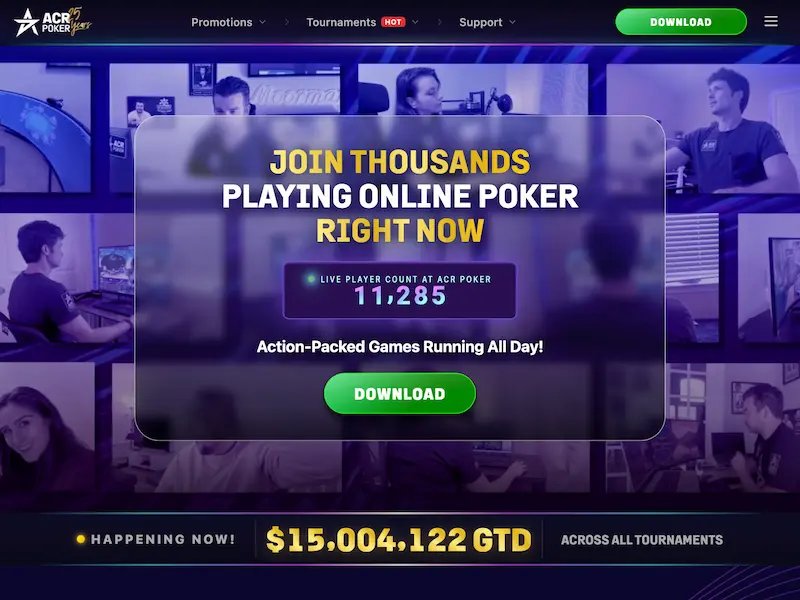
ACR Poker (Americas Cardroom) has operated since 2001 – it’s one of the longest-running US-facing rooms, and that history shows in the traffic. Cash game lobbies carry active tables at micro and mid-stakes on weekday evenings, and the tournament schedule runs 10+ events daily in its High Five series. A recent $1.325 million prize pool event with a $25,000 + $500 buy-in demonstrates the ceiling of what the room offers high-volume players.
The Award Points system is straightforward: 27.5 points per $1 of rake, releasing $1 of bonus per threshold crossed. Over 60 days, an active player at NL50 can realistically clear a significant portion of the $2,000 welcome bonus while banking 27% weekly rakeback on top. That combination – welcome bonus plus ongoing rakeback – puts effective returns in the 40%+ range for the first two months. Bitcoin withdrawals process in under an hour for verified accounts. Players from California, Florida, and Arizona all have confirmed access.
Verdict: ACR Poker delivers the best combination of tournament depth, US access, and ongoing rakeback for players who generate consistent volume.
Top Features:
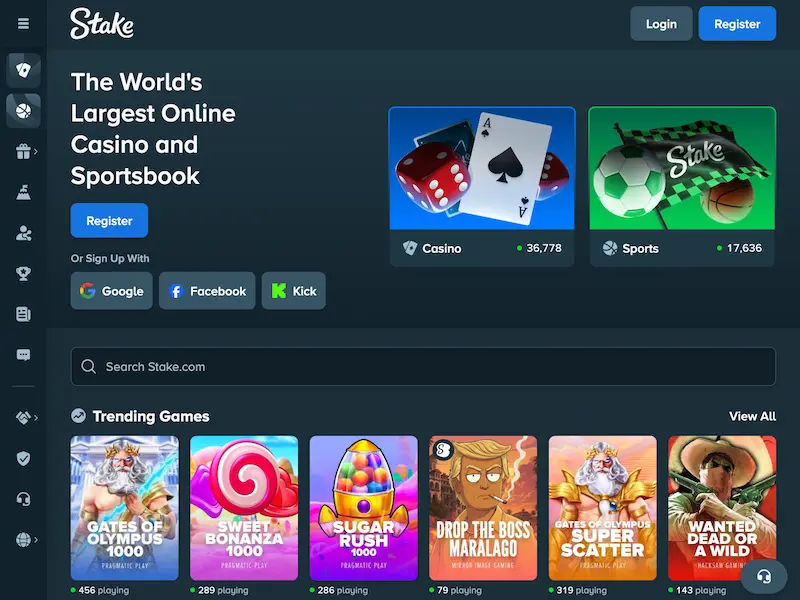
Stake.us operates under a sweepstakes model, which means no direct cash deposits – you buy Gold Coin packages or earn Stake Cash through free daily paths, then redeem Stake Cash prizes for cryptocurrency. That structure lets it run legally in most US states without a traditional gaming license. For players who want to play real poker without wiring money into an offshore account, it’s the cleanest option available.
The poker client is genuinely strong: run-it-twice, manual straddles, multi-tabling, and table customization are all present. The daily freeroll schedule runs several tournaments with fields around 1,000 players and prize pools of 50-200 SC. Buy-ins for paid events start at 0.11 SC. Rakeback credits automatically at 3.5% in real time with no opt-in. Crypto redemptions from Stake Cash typically land in your wallet within one to two hours. The platform is unavailable in a list of states, including Nevada, New Jersey, and Michigan, so check your state before registering.
Verdict: Stake.us is the best option for US players who want real poker action – daily freerolls, modest-stakes MTTs, and steady automatic rakeback – without traditional real-money deposits.
Top Features:
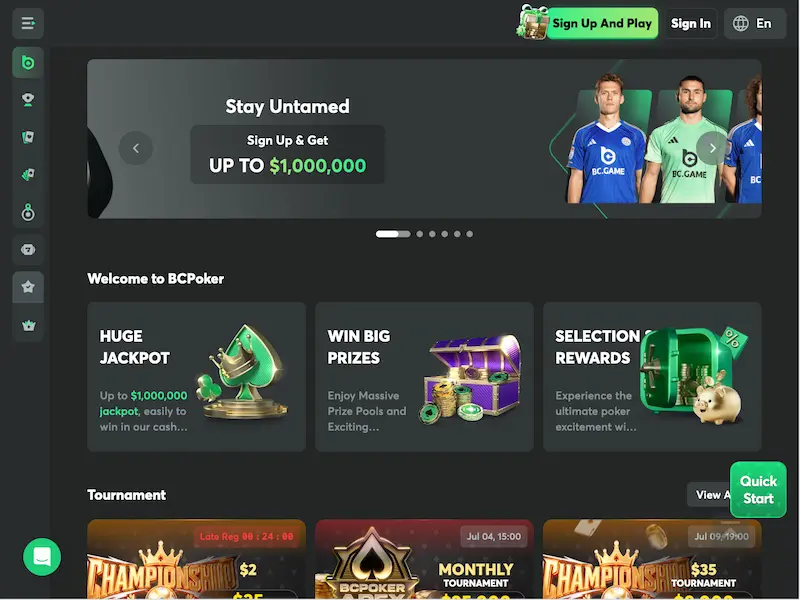
BC Poker launched in 2025 as the dedicated poker arm of the BC.Game system, and it shows in the infrastructure: proof-of-reserves, AI-driven behavior detection, liveness checks, and wormhole/emulator detection give it a security stack that most offshore rooms don’t come close to matching. The VIP rakeback ladder scales from 10% at Bronze I to 50% at the Royal tiers, with cumulative upgrade gifts totaling roughly $2,230 for players who grind to the top. Cash tables run Hold’em and PLO, with Short Deck, All-in or Fold, and Spin & Go formats adding variety.
The $25,000 GTD monthly BC Poker Apex (buy-in: $50) is the flagship tournament, with $5 satellite paths offering multiple seats. Crypto withdrawals process in approximately five minutes. The room’s player pools are still developing at mid-stakes and above, with traffic concentrated at low-stakes Hold’em tables.
US restriction note: BC Poker does not accept players physically located in the United States. US-based players cannot register or play for real money.
Verdict: BC Poker offers the most aggressive rakeback structure and strongest security stack of any 2026 offshore room, recommended for international players who want a grinder-focused crypto platform.
Online poker is fully licensed and regulated in five US states. Every other state sits in a gray market where players access offshore sites operating under international licenses, and no individual player has faced federal prosecution for doing so.
The five licensed states are Nevada, New Jersey, Pennsylvania, Michigan, and Delaware. Outside those five, players in most states – including California, Florida, and Arizona – reach real-money poker through offshore rooms. Those rooms operate legally in their licensing jurisdictions. The question of whether playing is legal for you depends on your state, and in most cases the answer is: no state law explicitly criminalizes individual play.
Nevada, New Jersey, Pennsylvania, Michigan, and Delaware all have licensed online poker options and regulated banking. California, Florida, Arizona, Texas, and New York do not license online poker, so players typically rely on offshore access, with Bitcoin or other crypto serving as the most reliable payment method. In licensed states, offshore access may still exist as an alternative, but regulated platforms remain the main in-state option.
Is online poker legal in California? No state law licenses or explicitly permits online poker – but no California law explicitly criminalizes individual play either. The gray market status means offshore sites serve California players freely, and online poker legal California questions tend to arise from players who want clarity on their personal risk. That risk, practically speaking, is negligible. Multiple legislative attempts to license California online poker have stalled, with tribal gaming interests and card rooms unable to agree on a regulatory framework.
Is online poker legal in Florida? Same answer. Florida has no state online poker licensing regime. The Seminole Hard Rock compact governs in-person gaming only. Offshore sites accept Florida players, and there are no recorded individual prosecutions for online poker play in the state. Online poker in Arizona sits in the same category: tribal compacts cover live poker, sports betting was legalized in 2021, and online poker in Arizona remains unregulated at the state level with no individual enforcement history.
Nevada is the only state where this matters differently. Online poker Nevada is fully regulated, and WSOP.com NV and BetMGM Poker NV are the two licensed platforms. Playing online poker Vegas residents can legally access requires physical presence within Nevada’s borders – geo-location software enforces this in real time.
If you’re thinking about online poker in Vegas or online poker Las Vegas specifically: you must be physically in Nevada to use a licensed platform. Cross a state line and you’re locked out. Offshore sites remain accessible as an alternative without that restriction.
Is online poker legal in Arizona? Arizona has no online poker licensing law. Tribal gaming compacts govern live poker in the state. Sports betting launched after the 2021 legalization, and online poker legalization discussions are active but unresolved. Arizona online poker players access offshore sites in the same gray market as California and Florida – no recorded individual prosecutions, no explicit state prohibition on individual play.
The Unlawful Internet Gambling Enforcement Act of 2006 (UIGEA) targets payment processors and financial institutions – not individual players. It makes it illegal for banks to knowingly process payments to online gambling sites. It does not make it illegal for you to play.
The practical effect: your Visa or Mastercard will often decline at offshore poker sites because banks flag gambling merchant codes. That’s a banking restriction, not a personal legal risk. Bitcoin and other cryptocurrencies bypass this entirely, which is why crypto has become the default deposit method for US players at offshore rooms.
Real money play differs from free play in three fundamental ways: the player pool is harder, rake costs you money at every table, and your bankroll needs to be sized correctly before you sit down.
Online poker players in Florida access through offshore sites uses the same deposit and withdrawal routes as players from every other unregulated state. They say that online poker in Florida for real money works best through Bitcoin – card deposits fail routinely due to UIGEA merchant code blocking, and e-wallets have mixed success depending on the processor. If you want online poker for real money in California, the same logic applies: crypto is your most reliable on-ramp.
Online poker California real money accounts at offshore sites require no KYC upfront for most platforms. KYC verification – identity documents, address proof – typically triggers when you request your first significant withdrawal, usually above $2,000 at most offshore rooms. Online poker real money California players should complete KYC before they need it, not after. Prepare a government ID and proof of address before your first cashout request.
Poker online Florida rooms, California offshore sites, and every US-facing operator charges rake. Two structures are common. Pot rake takes a percentage of each pot – typically 4-5% capped at a fixed dollar amount depending on stakes. Time charge (or “seat charge”) takes a fixed fee per 30-minute period regardless of hands played, common at higher stakes.
At NL25 ($0.10/$0.25), rake of 5% capped at $1.25 per pot makes sense only if you’re winning enough per pot to overcome it. At NL10 ($0.05/$0.10), rake can eat 15-20% of your expected value per hour if you’re marginally profitable. This is why rakeback matters more at lower stakes than at higher stakes – the rake is proportionally larger relative to pot sizes.
Legitimate free poker – multiplayer, real opponents, no download required in most cases – is widely available across several formats. The quality varies significantly depending on what you want.
Standalone free platforms are fine for learning. They won’t improve your real-money game much – the player pool plays nothing like a rake-paying opponent pool, and decisions carry no consequence. If you’re on the Nevada side and want something with poker Vegas online feel and no deposit, Stake.us’s free daily freerolls are the strongest option. The online poker Vegas crowd looking for free-entry, real-prize formats won’t find a better sweepstakes product for US players than Stake.us currently.
Video poker is a machine-based game played against the house, not against other players. It has nothing in common with table poker except the hand rankings. That distinction matters because the strategy, the math, and the expected value calculation are entirely different.
The critical variable is the paytable. Jacks or Better at 9/6 – meaning 9 coins returned per coin bet on a full house, 6 on a flush – returns 99.54% with correct strategy. The same game on an 8/5 paytable drops to 97.3%. Most offshore casino lobbies carry 8/5 or worse. Full-pay paytables exist at some Nevada land-based casinos and a small number of online platforms.
Video poker is the only casino game where correct play drops the house edge below 0.5%. Strategy charts are freely available and completely legal to use – the game is designed so optimal play still earns the house a margin, just a very small one. Playing without a chart on Deuces Wild or Double Double Bonus costs you multiple percentage points of return.
Three card poker is a table game dealt against the dealer. You receive three cards, the dealer receives three cards. Your decision is binary: match the ante with an equal “play” wager, or fold and lose your ante. There’s no draw, no additional cards.
The Pair Plus side bet pays based purely on your hand regardless of the dealer’s cards. It operates as a separate wager you can make alongside or independently of the ante/play structure.
Live dealer three card poker replicates the in-person experience – a real dealer, real card shuffles visible on camera, natural pacing. RNG (random number generator) versions play faster and suit lower-stakes play, with minimums as low as $0.50 per hand at some offshore casino lobbies. If you want consistent low-minimum 3 card poker tables, offshore casino lobbies attached to poker sites – Bovada Casino, BetOnline Casino – carry live and RNG versions with minimums accessible to smaller bankrolls.
Poker site bonuses don’t work like casino bonuses. You don’t get a lump sum to play with. Most are incremental release systems tied to rake generation – you earn your bonus dollar by dollar as you play real money hands.
The standard structure: deposit, receive a “pending bonus” in your account, generate rake to unlock it. ACR Poker releases $1 per 27.5 Award Points earned – at NL25 generating $3-4 per hour in rake, that’s roughly $3-4 in bonus released per hour. The 60-day window means you need consistent volume to capture the full $2,000. Black Chip Poker runs the same structure (same network, same Award Points system). Ya Poker’s SMPBONUS offer matches that with the same 27.5 AP/$1 release rate over 60 days.
CoinPoker’s COINBONUS releases in 10% increments as fees accumulate – a different mechanic but the same principle. The 150% up to $2,000 offer is the highest percentage of any major US-facing room, but the full value requires proportionally more play than a standard 100% match. BetOnline’s POKER1000 offer releases $5 for every $50 in rake over 30 days – a 10% effective return while active, with the tighter 30-day window making it better for high-volume players.
For California online poker players and Nevada online poker access, offshore rooms carry identical bonus structures. Licensed Nevada platforms like WSOP.com NV and BetMGM Poker NV run separate, state-specific promotions that are only accessible while physically in Nevada.
Poker online California players and those seeking California online poker bonuses at offshore rooms should note that all the above sites service California access without restriction.
Free entry, real prize pools – freerolls are the one genuinely no-cost route to winning money online. But quality varies. Black Chip Poker’s daily $50 GTD freerolls run in 8-max and 6-max formats with 2,000-entry caps – worth playing. ACR Poker runs satellite freerolls feeding high-value tournaments. CoinPoker’s CoinRaces and splash pot structures function as rolling freeroll-adjacent rewards.
Free Vegas poker online options for Nevada-licensed platform players are more limited – WSOP.com NV and BetMGM Poker NV run periodic freerolls but at lower frequency than offshore rooms. Offshore sites carry more freeroll volume.
Watch for these in any bonus terms before depositing
Your deposited funds and your bonus balance are separate. The deposited cash is yours to withdraw at any time. The bonus is locked until rake thresholds are met – only the cleared portion becomes withdrawable.
This is the most misunderstood point in online poker real money Florida discussions: if you deposit $200 and claim a 100% up to $200 bonus, you can withdraw your $200 deposit immediately. The $200 bonus is the part that needs rake-clearing. Online poker Florida real money cashouts of deposited funds face no bonus delay at properly structured sites.
Poker online Florida players and those accessing Florida poker online from offshore rooms will find crypto the only reliably fast option. Bank wires work, but a two-week wait on a withdrawal is a real cost. Florida poker online via crypto eliminates that entirely.
Online poker has genuine advantages over live play and genuine drawbacks worth understanding before you deposit.
Every site in this guide was evaluated with a funded account, at least one cash game session played, and one withdrawal processed. Here’s what determined the rankings.
State law varies more than most players realize. The difference between playing in Nevada and playing in California is not just regulatory – it affects which platforms you can access, which payment methods work, and whether geo-location restrictions apply to you.
California, Florida, and Arizona remain gray-market states for online poker, with no licensed platforms and offshore access serving as the practical route for players. Nevada is a licensed market with WSOP.com NV and BetMGM Poker NV, where regulated banking works, and offshore sites remain an alternative.
Online poker in California operates entirely through offshore rooms – no state-licensed platform exists. California is the largest poker state in the US by player volume, and the absence of regulated online poker is the result of a decade-long legislative standoff between tribal gaming operators and card room owners, not a prohibition on individual play.
Is online poker legal in California? No law explicitly legalizes it at the state level, but no California statute criminalizes individual play either. Online poker legal California status is gray market: unregulated, not outlawed, consistently accessible via offshore sites. Multiple bills have reached committee and stalled since 2016 – tribal interests and card rooms have not been able to agree on a licensing framework.
For online poker California real money access, Bitcoin is the most reliable deposit and withdrawal route. Skrill and Neteller work at some sites. Standard card deposits often fail. California online poker players on offshore rooms have access to every major US-facing site: ACR Poker, CoinPoker, BetOnline, Ya Poker, Black Chip Poker, Bovada, and Ignition Poker all service the state. Online poker for real money in California has no meaningful practical barrier beyond the deposit method.
Online poker real money California accounts function identically to accounts from other unregulated states – same welcome bonuses, same rakeback structures, same withdrawal timelines. Poker online California players should use Bitcoin as their primary banking method and treat offshore KYC as a requirement to prepare for before their first large withdrawal, not after.
Poker in the Sunshine State follows the same pattern as California: no state licensing regime, Seminole Hard Rock compact covers live gaming only, offshore sites fully accessible.
Is online poker legal in Florida? No state law makes individual play illegal. Florida online poker through offshore rooms carries the same negligible personal legal risk as every other unregulated state.
Poker players in Florida use Bitcoin as the primary deposit route for the same reason as every other state – UIGEA banking restrictions block standard card transactions at offshore gambling sites. Online poker Florida real money is practically accessible at all major US-facing offshore rooms. Florida poker online via crypto processes at the same speeds as any other state: under an hour for BTC at ACR Poker and Ya Poker, same-day at BetOnline.
Poker online Florida players should note that Bovada restricts a small number of states but Florida is not among them – it’s one of Bovada’s primary US markets. Online poker in Florida via Bovada, ACR Poker, CoinPoker, and BetOnline gives you consistent access across every major offshore network.
Nevada is where online poker in the US started, and it remains the most developed regulated market. WSOP.com NV and BetMGM Poker NV are the two licensed platforms serving Nevada residents. Nevada online poker requires physical presence – geo-location software verifies your location before you can sit at a table.
Online poker Las Vegas players have the full licensed product: regulated software, player fund protection, licensed RNG, and state oversight. Online poker Vegas access via a licensed platform means you’re playing within a regulated framework with real consumer protections. Online poker in Vegas at WSOP.com NV connects you to the shared player pool with New Jersey, which significantly increases traffic and tournament field sizes.
If you want online poker in Vegas without the geo-location constraint, or if you’re passing through Nevada and want to continue playing after crossing the state line, offshore sites like ACR Poker and CoinPoker are accessible from Nevada as an alternative. Free Vegas poker online options exist through free-play lobbies at offshore rooms, and the Stake.us sweepstakes platform is not available in Nevada, so the offshore free-play lobbies are your primary option for poker Vegas online play without a real-money deposit from inside Nevada. Note that Bovada restricts Nevada residents from its platform.
Arizona online poker sits firmly in the gray market. Online poker Arizona players access offshore rooms under the same conditions as Florida and California – no state licensing, no individual enforcement history, full access to major offshore sites.
Is online poker legal in Arizona? No Arizona state law explicitly criminalizes individual online poker play. Online poker in Arizona is unregulated, not prohibited. Tribal compacts govern live poker. Sports betting legalization in 2021 opened the door to broader online gambling conversations, and Arizona online poker legislation discussions have followed – but as of 2026 no bill has progressed to enactment.
Online poker Arizona players use Bitcoin as the primary deposit method. ACR Poker, BetOnline, CoinPoker, and Ya Poker all accept Arizona residents. The access picture for Arizona online poker is identical to California and Florida – every major offshore US-facing room services the state.
Online poker accelerates risk in ways that live poker doesn’t. You can play 200+ hands per hour online versus 25-30 at a live table. Multi-tabling compounds that. The 24/7 availability means there’s no natural stopping point – the game is always running.
Set your session limits before you sit down. Treat them as non-negotiable – not a suggestion you revisit when you’re running bad.